Japanese Road Signs on the Written Test: The 5 Types Explained
Last updated: 21 July 2026
Japanese road signs come in five families: regulatory (規制 — prohibitions and limits, mostly red/blue circles), instruction (指示 — blue squares that grant or mark something), warning (警戒 — yellow diamonds for a hazard ahead), guide (案内 — blue or green rectangles for directions), and supplementary plates (補助 — small white plates under a main sign that add a time, vehicle, or distance). For the written test the ones that decide right/wrong answers are almost all regulatory and instruction signs — no entry, no stopping/parking, speed limit, one-way, pedestrian crossing, priority road — because those are the ones that change what you are legally allowed to do.
How many kinds of road sign are there in Japan?
Japanese road signs (道路標識) split into main signs and supplementary plates. The main signs are four types — guide, warning, regulatory, and instruction — and the supplementary plate is a fifth element that modifies a main sign. That is the classification used by the Ministry of Land, Infrastructure, Transport and Tourism.
Who installs them tells you their job: guide and warning signs are put up by road administrators (national government, prefecture, city), while regulatory and instruction signs are set mainly by the prefectural public safety commission — the police. That is why regulatory and instruction signs carry legal force you must obey.
Regulatory signs (規制標識) — the ones that ban and limit
Regulatory signs tell you what you must not do or must limit: no entry, no U-turn, no stopping or parking, maximum speed, one-way, no overtaking. They are the most heavily tested family because breaking one is a violation.
Most are circles. A red circle with a slash or red border means prohibition; a blue circle usually means a required direction or designated use. Example rule the test checks: where a sign prohibits U-turns, you may not make one even if you would not obstruct anyone (Road Traffic Act Art. 25-2) — the sign, not the traffic situation, decides.
Instruction signs (指示標識) — the ones that permit or mark
Instruction signs mark something you may rely on or must follow: a pedestrian crossing, a priority road, a place where parking is permitted, a designated lane. They are typically blue squares.
They matter on the test because they interact with the rules of the road. For example, a priority road sign changes who must give way at an intersection, and a pedestrian crossing sign marks where pedestrians have absolute priority and you must be ready to stop.
Warning signs (警戒標識) — hazard ahead
Warning signs are yellow diamonds that tell you a hazard is coming: a curve, a crossroads, a railway crossing, falling rocks, road works, or slippery road. They do not by themselves impose a legal duty the way a regulatory sign does, but they tell you to prepare.
On the test they appear as recognition items ('what does this yellow diamond mean?') and in combination with duties — for example, approaching a railway crossing you must be able to stop, which the warning sign is telling you to expect.
Guide signs (案内標識) and supplementary plates (補助標識)
Guide signs are the blue (ordinary roads) or green (expressways) rectangles that show directions, distances, and place names. They rarely decide a true/false answer but appear as recognition questions, and the blue-vs-green colour is a classic point.
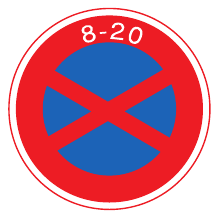
Supplementary plates are the small white plates fixed under a main sign that narrow it down — a time window ('8–20'), 'except Sundays and holidays', a vehicle type, or a distance the rule applies for. The trap on the test: a 'no parking' sign with a plate reading '8:00–20:00' does not ban parking at night, so read the plate before you answer.
Which signs should I focus on for the test?
Focus on regulatory and instruction signs, because they are the ones that change what you may legally do — and therefore the ones that make a true/false statement true or false. Learn the prohibition circles (no entry, no stopping/parking, no overtaking, speed limit, no U-turn) and the key instruction signs (pedestrian crossing, priority road).
Then practise them inside full statements, not as flashcards, because the test never just shows a sign — it wraps it in a rule ('where this sign is posted, you may still... '). The 'signs and signals' topic on this site has 155 such questions, each tied to the exact law.
FAQ
- How many types of Japanese road sign are there?
- Four main types — guide (案内), warning (警戒), regulatory (規制), and instruction (指示) — plus supplementary plates (補助) that modify a main sign. Regulatory and instruction signs are the ones with legal force.
- What does a yellow diamond sign mean?
- It is a warning sign, telling you a hazard is ahead — a curve, crossroads, railway crossing, slippery road, or similar. It asks you to prepare rather than imposing a direct prohibition.
- Why are some guide signs blue and some green?
- Blue guide signs are used on ordinary roads; green ones are used on expressways and motor-vehicle-only roads. The information is the same kind — directions, distances, place names — only the road class differs.
- Do I have to memorise every sign for the test?
- No. Concentrate on regulatory and instruction signs, since those change what you are legally allowed to do and drive the true/false answers. Guide signs mostly appear as simple recognition.
Practise with a full 50-question mock test, free.
Start a 50-question testAdvertisement
Related questions
Browse questions by topic
Related terms
Sources
- MLIT — road-sign basics (five families, colours, who installs them) (official source)
- e-Gov — Road Traffic Act (sign-based duties: U-turn ban, parking, priority) (official source)
- Osaka Prefectural Police — written-test format (official source)
Update history
- 21 July 2026 — First published.