Signs, signals and markings
608 questions
Take a 50-question test on this topic- Pedestrians and vehicles using the road must obey the signals shown by traffic lights.
- A police officer's hand signal is only a suggestion, so you only need to follow the traffic lights.
- Under the Road Traffic Act, "night" means the period from sunset until sunrise.
- The duty to turn on lights applies only at night; there is never a case where lights must be used during the daytime.
- At night, when meeting an oncoming vehicle (passing in opposite directions) or driving directly behind another vehicle, if your lights could obstruct the other vehicle's traffic, you must switch your lights off or dim them.
- When leaving a roundabout, the driver must signal using a hand signal, turn indicator, or lights.
- For a right turn or lane change, you only need to signal once at the start; you do not have to keep the signal on until the action is finished.
- Once you have finished the turn or lane change, you must switch the signal off.
- When you are about to pass through a place designated by a road sign — such as a blind intersection or the top of a blind uphill slope — you must sound your horn.
- You may not sound your horn except where the law requires it, and you may not sound it even when it is unavoidably necessary to prevent danger.
- The duty to sound the horn when passing a place designated by a sign — such as a blind intersection — also applies to people using light vehicles other than bicycles, such as handcarts.
- If you have held a semi-medium (jun-chugata) licence for less than one year, you only need to display the mark on the front of the vehicle.
- If you are aged 75 or over and hold a licence allowing you to drive an ordinary car, you only have to make an effort to display the older-driver (koreisha) mark, and you commit no offence by not displaying it.
- If you are aged 70 to 74 and age-related decline in physical function may affect your driving, you should make an effort to display the older-driver mark.
- When counting how long a driver has held the licence for the beginner mark rule, periods during which the licence was suspended are also counted.
- The beginner mark duty for a semi-medium licence applies to anyone who has held the licence for a total of less than two years.
- When a three-colour traffic light is arranged horizontally, the lamps are placed in the order red, yellow, green from the right.
- When a three-colour traffic light is arranged vertically, the lamps are placed in the order green, yellow, red from the top.
- A pedestrian signal with a human figure changes in the order: green, flashing green, then red.
- When a police officer waves a light from side to side, traffic moving in the direction the light is being waved should treat it the same as a green light.
- When a police officer waves a light from side to side, traffic travelling in the direction that crosses the direction of the waving should treat it the same as a yellow light.
- When a police officer raises the light above their head, traffic travelling in the direction the light had been waved just before should treat it the same as a yellow light.
- When stopping for a light signal at a place without a stop line, you must stop 5 meters before the police officer giving the signal.
- At an intersection marked to allow left turns, you may still turn left even when a light signal has the same meaning as a red light.
- When a police officer holds one arm out horizontally, traffic moving parallel to that arm is given the same meaning as a green light.
- When a police officer holds an arm out horizontally, traffic facing that arm is being given the same meaning as a green light.
- When a police officer raises an arm vertically, traffic that was running parallel to the previously horizontal arm is being given the same meaning as a yellow light.
- Where a hand signal has the same meaning as a yellow or red light, at certain locations the stopping point is 1 meter before the police officer or traffic patrol officer giving the signal.
- At an intersection with a sign posted by the Public Safety Commission allowing left turns, a vehicle still may not turn left while the officer's hand signal has the same meaning as a red light.
- When the light turns yellow, if you are already too close to the stop position to stop safely, you may continue through.
- When the light is red, a vehicle or streetcar that has already begun turning left inside the intersection may continue on.
- When the light is red, a light vehicle such as a bicycle that has already begun turning right in the intersection may simply continue the turn.
- When the light is red, a car already turning right in the intersection may continue, but must not obstruct vehicles that have a green light.
- At a flashing red light, a vehicle only needs to slow down and may proceed without making a full stop.
- At a flashing yellow light, both pedestrians and vehicles must always come to a complete stop.
- On a green light, cars and streetcars may go straight, turn left, or turn right.
- On a green light, light vehicles such as bicycles and specified small motorized bicycles (electric kick scooters) may turn right directly at the intersection in the same way as cars.
- When a green arrow signal is shown, vehicles may proceed in the direction of the arrow even though the light is yellow or red.
- When a yellow arrow signal is shown, all vehicles may proceed in the direction of the arrow.
- When the pedestrian signal shows a green walking figure, an ordinary bicycle may go straight or turn left across the crosswalk.
- When the pedestrian signal with a walking figure is flashing green, a pedestrian who has not yet started may still begin crossing.
- Even where a stop line is painted on the road, the stop position is determined without regard to that line.
- Where an intersection displays a "left turn permitted" sign, vehicles may turn left even when the light is yellow or red.
- On expressways and motor-vehicle-only roads, you must turn on your lights when driving through dark places such as tunnels or heavy fog where visibility is 200 meters or less.
- On ordinary roads, in dark places where fog reduces visibility to 50 meters or less, you must use lights while driving, but you do not need them while stopped or parked there.
- A car whose driving beam (high beam) exceeds 10,000 candela and that is fitted with a passing beam (low beam) or front fog lamps must, when meeting an oncoming vehicle, switch on the low beam or fog lamps and switch the high beam off.
- A moped (motorized bicycle) using a headlamp brighter than 10,000 candela must also reduce the light intensity or aim the beam downward when meeting another vehicle.
- When meeting another vehicle, a trolley bus is only allowed to aim its headlamps downward and may not instead reduce the light intensity.
- At night, a moped (gentsuki) must switch on both its headlight and its tail lamp when riding on the road.
- At night you do not have to switch your lamps on inside a tunnel that is lit well enough to see 200 m ahead on an expressway, or 50 m ahead on other roads.
- At night a car only needs its headlights on; the clearance lamps, tail lamps and licence-plate lamp may stay off.
- When you are towing another vehicle, you are not required to show your tail lamps or licence-plate lamp.
- A vehicle being towed by another vehicle must always keep its headlights on at night.
- Light vehicles (keisharyo — bicycles, handcarts and other non-motorised vehicles) do not need any lamp when travelling on the road at night.
- When turning left at an intersection, you must start signaling when you reach a point 30 meters before the near edge of the intersection.
- When changing lanes to the left while continuing in the same direction, you must signal 3 seconds before you start the move.
- When turning right, you must start signaling 50 meters before the near edge of the intersection.
- When changing lanes to the right while continuing in the same direction, signaling 1 second before the move is enough.
- When slowing down or stopping, you must signal 3 seconds before you do it.
- To signal reversing with your arm, extend it outside the vehicle diagonally downward, turn your palm backward, and move the arm back and forth.
- When slowing down or stopping inside a roundabout, you must begin signaling 30 meters beforehand.
- A person who, at some point within the 6 months before obtaining their current semi-medium vehicle licence, already held the corresponding higher-class licence is exempt from displaying the beginner driver mark.
- Exemption from the beginner driver mark requires that the previous semi-medium vehicle licence was held for a combined total of at least 3 years.
- A person who held a foreign licence for a vehicle equivalent to a semi-medium vehicle within the 6 months before obtaining the Japanese licence, and who stayed in that country for a combined total of at least one year while holding it, is exempt from the beginner driver mark.
- When calculating how long the person held the semi-medium vehicle licence they held immediately before, in order to judge whether they are exempt from displaying the beginner driver mark, any period during which that licence was suspended is also counted.
- A person who obtains a higher-class licence after receiving their semi-medium vehicle licence is also exempt from displaying the beginner driver mark.
- Anyone who held the previous semi-medium vehicle licence for a year or more is always exempt, even if that licence was revoked.
- A holder of an ordinary vehicle licence may also be exempt from the beginner driver mark if, within the 6 months before obtaining it, they had held a semi-medium vehicle licence for a combined total of at least one year.
- When exemption from displaying the beginner driver mark is judged on the basis of a foreign licence, time spent staying in that country is irrelevant; only the length of time the foreign licence was held decides it.
- On the "left turn permitted" sign board, the arrow and the frame are blue and the background is white.
- On the fire-fighting water supply sign, the frame is blue and the background is red.
- On the board indicating that a parking-ticket dispenser is present, the rectangular symbol part has white letters on a blue background.
- When the light turns yellow and you are already so close to the stop position that you cannot stop safely, you may continue through.
- At a flashing red light, a vehicle must make a complete stop at the stop position.
- At a flashing yellow light, a vehicle must always come to a complete stop at the stop position.
- When a green arrow points to the right, you may not only turn right but also make a U-turn.
- When a right-pointing green arrow is shown, light vehicles such as bicycles may also proceed following that arrow.
- When a yellow arrow signal is shown, cars as well as streetcars may proceed in the direction of the arrow.
- On a green light, a bicycle may turn right directly by going around the center of the intersection.
- A vehicle that has already begun its left turn in an intersection may continue even if the signal for the direction it is turning to has turned red.
- When a police officer raises an arm horizontally to the side, traffic moving parallel to the front of the officer's body is treated as having a green light.
- When a police officer raises an arm vertically, traffic moving parallel to the front of the officer's body is treated as having a red light.
- Where a police officer gives hand signals outside an intersection with no crosswalk, bicycle crossing or railroad crossing, the stop position is 3 meters before the officer.
- Where a signal is marked "for pedestrians and bicycles", a bicycle that is already too close to stop safely when the green starts flashing may continue across.
- When a pedestrian signal shows a red human figure, an ordinary bicycle about to cross on the crosswalk may still begin crossing.
- The "Parking Space Required" sign requires a driver to leave at least the distance shown on the supplementary plate on the left side of the parked vehicle.
- For the "Maximum Width" sign, only the width of the vehicle body matters, and the width of any load is not counted.
- The "Minimum Speed" sign designates the minimum speed for motor vehicles.
- Where the sign "No Passing by Crossing into the Right Half of the Road" is posted, passing is allowed as long as you do not cross into the right half of the road.
- Where the "no two-up riding for large and ordinary motorcycles" sign is posted, you may ride a large or ordinary motorcycle through as long as you carry no passenger.
- The "Motor Vehicles Only" sign (No. 27) designates expressways (national expressways) only.
- The sign for "Lane Designation for Towing Vehicles on Expressways" designates which lane a towing vehicle must use on the main carriageway of a national expressway when it is towing a vehicle whose gross weight exceeds 750 kg.
- In a section marked with the sign "First-Lane Designated Section for Towing Vehicles on Motor-Vehicle-Only Roads", a towing vehicle that is towing a vehicle whose gross weight exceeds 750 kg must drive in the second lane of the main carriageway.
- In a section marked with the "Horn Zone" sign, you must sound the horn at intersections where you have a clear view to the left and right.
- The "Parallel Parking" sign requires vehicles to park parallel to the edge of the road.
- Where the "Right-Angle Parking" sign is posted, vehicles must be parked at an angle to the roadside.
- The "Pedestrians Only" sign designates a road set aside for the passage of pedestrians only.
- There are two "permitted vehicles only" signs: one for route buses and chartered buses, and one for taxis.
- The "Slow Down" (jokō) sign designates that vehicles and streetcars must proceed slowly, at a speed that allows them to stop immediately.
- The "Priority Lane for Route Buses" sign designates a lane that only route buses are allowed to use.
- The "SLOW DOWN" sign applies only to cars, so streetcars do not have to slow down.
- The "PRIORITY ROAD AHEAD" sign means that the road crossing ahead of you, not the road you are on, is the priority road.
- The "NO CROSSING BY PEDESTRIANS" sign prohibits both pedestrians and remote-controlled small vehicles (delivery robots) from crossing the road there.
- On a sign such as "No Stopping or Parking", the numbers "8-20" mean the restriction applies from 8:00 to 20:00.
- The "Bicycles May Ride Side by Side" sign means up to three ordinary bicycles may ride abreast.
- The "Vehicles May Use Streetcar Track Area" sign means motor vehicles are allowed to drive on the streetcar track area.
- The "Parking Clearance" sign shows the space that must be left on the left side of the vehicle when you park.
- The "Center Line" sign indicates the position at which a vehicle should stop.
- The supplementary sign "Day/Time" is used to specify which types of vehicles the restriction applies to.
- On the Beginner Driver mark, the left half of the background is yellow and the right half is green.
- On the Hearing-Impaired Driver mark, the background is green and the symbol is yellow.
- On the Physically Disabled Driver mark, the background is red and the edge and symbol are white.
- The Provisional Licence Practice plate has black lettering on a white background, and must be made of metal, wood, or another sufficiently durable material.
- The Personal Mobility Vehicle mark has a white edge and symbol with a blue-green background made of reflective material.
- The Reserved Parking Space permit sticker has black lettering on a white background with a gold symbol.
- No part of the Older Driver mark uses reflective material.
- The Abandoned Vehicle Confirmation sticker has a white background, with the symbol and the words "abandoned vehicle" printed in blue.
- The "first-lane designated section for towing vehicles on motor-vehicle-only roads" marking indicates a section where a vehicle towing a trailer or other vehicle with a gross weight of more than 750 kg must drive in the first (leftmost) lane of the main carriageway of a motor-vehicle-only road.
- The "traffic guide zone" marking shows a part of the road where vehicles are given priority to drive, in order to guide traffic safely and smoothly.
- The "safety zone" marking is drawn with a white outer frame and a yellow inner frame.
- Where the "parallel parking" marking is present, a vehicle must park inside the marked section, parallel to the edge of the road.
- Where the "angle parking" marking is present, you may park facing any direction as long as the vehicle is inside the marked section.
- The "priority road ahead" marking warns that the road crossing ahead is a priority road.
- The warning sign "traffic signal ahead" has a yellow background with a black border and symbol (excluding the circles that represent the signal lights).
- Among "maximum speed" road markings, there is one that sets a speed limit of 30 km/h or less for mopeds (gentsuki).
- Where the "No Parking" road marking is present, both parking and stopping are prohibited.
- The "Do Not Stop Zone" marking shows an area that vehicles and trams must not enter when traffic is congested and they would be likely to end up stopped inside it.
- In a road-side strip marked as a "pedestrian-only road-side strip", cars may not enter but light vehicles such as bicycles may still pass through.
- The marking for "expressway lane designation for towing vehicles" applies to towing vehicles pulling a vehicle with a gross weight of over 500 kg.
- The "keep-out area" marking indicates a section of road that vehicles must not drive into.
- The numbers written on the "no U-turn" road marking indicate the hours during which U-turns are prohibited.
- Where the marking "no crossing to the right side of the road to overtake" is present, all overtaking of any kind is prohibited.
- The "no lane change" marking always prohibits lane changes for vehicles in the lanes on both sides of it.
- The "route bus priority lane" marking indicates a lane reserved exclusively for route buses.
- The "priority main carriageway" marking shows that the main carriageway ahead, which this one merges into, is the priority road.
- The "No Overtaking" sign means vehicles are prohibited from overtaking.
- The "Priority Road Ahead" sign indicates that the road on which the sign stands is the priority road.
- The "School Route" sign marks a section used by university students going to their university.
- The "Animal Crossing" sign warns that vehicles carrying animals use this section of road.
- The "Crosswind" sign warns that strong side winds may occur and care is needed.
- The "Railroad Crossing" warning sign indicates that there is a level crossing ahead requiring caution.
- A sign reading "End" indicates that the traffic restriction shown by the main sign starts at that point.
- A plate reading "Reason for Restriction" shows the reason for the traffic restriction indicated by the main sign.
- A plate reading "Caution" means vehicles and streetcars need to be driven with special care.
- The "Destinations, Directions and Distances" guide sign (No. 107) has white letters, arrows and border on a blue background.
- The "Destinations and Distances" guide sign (No. 109) has white letters on a red background.
- The "Detour" guide sign (No. 150) has red letters and a red frame with a blue arrow.
- To count as "軽" (kei), a combustion-engine vehicle must have an engine displacement of 1000cc or less.
- The abbreviation "大型バス" (large bus) means a large passenger vehicle with a seating capacity of 30 or more.
- The abbreviation "けん引" (towing) refers to a tow vehicle pulling a vehicle with a gross weight over 350 kg.
- The "小二輪" (small two-wheeler) category includes ordinary motorcycles with an engine of 125cc or less, or a rated output of 1.00 kW or less.
- The abbreviation "大型等" refers only to large motor vehicles.
- The abbreviation "大貨等" includes large special vehicles in addition to large trucks and specified medium-sized trucks.
- The abbreviation "マイクロ" (micro bus) refers to large passenger vehicles with a capacity of 30 or more.
- The abbreviation "大貨" means a large motor vehicle other than a large passenger vehicle.
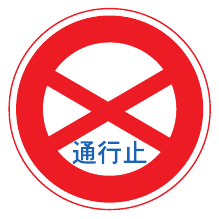 Where this sign is posted, pedestrians as well as vehicles are barred from passing.
- This sign means that vehicles may not pass but pedestrians may.
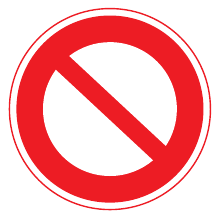 Where this sign is posted, bicycles are barred as well as cars and mopeds.
- This sign also bans pedestrians from passing.
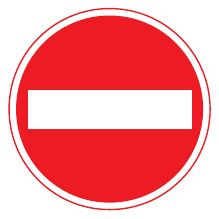 Vehicles must not enter where this sign is posted.
- This sign means that the road ahead is closed.
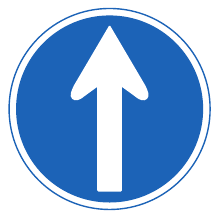 At an intersection with this sign, vehicles may only go straight ahead.
- At an intersection with this sign, vehicles may turn right.
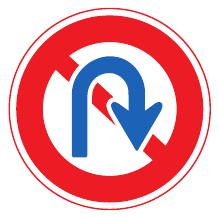 Where this sign is posted, vehicles must not make a U-turn.
- This sign prohibits vehicles from reversing.
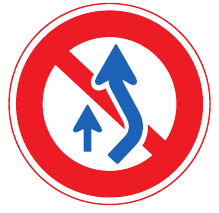 Where this sign is posted, you must not cross into the right half of the road in order to overtake.
- This sign bans even overtaking that stays out of the right-hand side of the road.
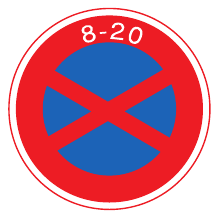 Where this sign is posted, you may not even stop briefly to let someone get in or out.
- This sign prohibits parking only; stopping is allowed.
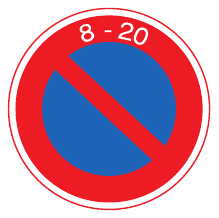 Even where this sign is posted, you may stop to let someone get in or out.
- Where this sign is posted, stopping is prohibited as well.
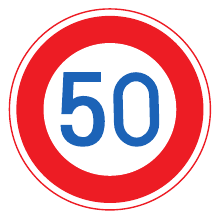 On a road with this sign you must not drive faster than 50 km/h.
- This sign means that you must not drive slower than 50 km/h.
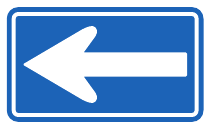 On a road with this sign, vehicles must not travel against the arrow.
- This sign prohibits travelling in the direction the arrow points.
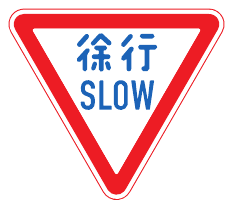 Where this sign is posted, vehicles must proceed at a speed that lets them stop immediately.
- This sign requires vehicles to come to a complete stop.
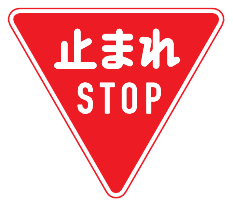 Where this sign is posted, you must stop just before the stop line.
- At an intersection with this sign, I had checked that both directions were clear, so I passed through slowly without stopping.
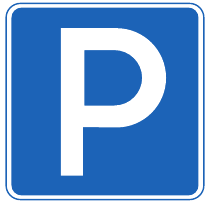 Where this sign is posted, vehicles may park.
- The "parking permitted" sign shows that you may park on that part of the road itself; it is not there to guide you to the entrance of a car park.
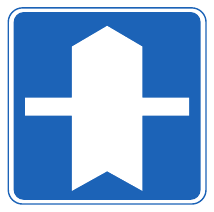 While travelling on a road with this sign, you have precedence over vehicles coming from the crossing road.
- Even when travelling on a road with this sign, you must always slow down at intersections where you cannot see left and right.
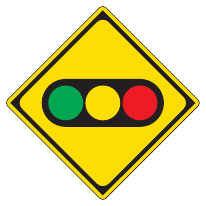 This is a warning sign telling you that there is a traffic signal ahead.
- This sign means you must come to a complete stop at the signalled intersection.
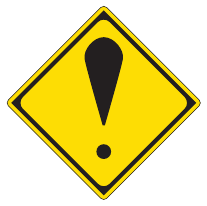 This sign warns of a hazard that the other warning signs cannot express.
- This sign means only that there are roadworks ahead.
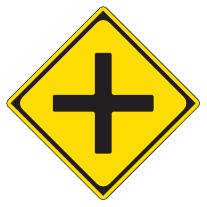 This sign warns that a four-way crossroads lies ahead.
- This sign warns that there is a hospital ahead.
- On a road with this sign, an unsignalled crossroads was coming up, so I proceeded watching for traffic on the crossing road.
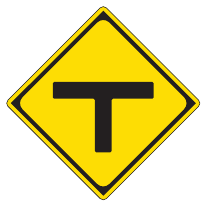 This sign warns that a T-junction lies ahead.
- This sign warns that a four-way crossroads lies ahead.
- Seeing this sign, I decided whether to go left or right at the T-junction ahead and slowed down before reaching it.
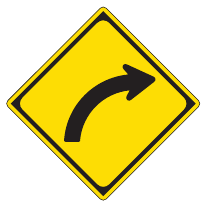 This sign warns that the road ahead curves to the right (or left).
- This sign means you must turn right at that point.
- Seeing this sign, I slowed well down on the straight before entering the bend.
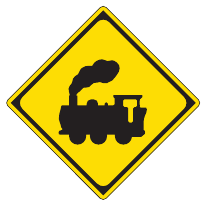 This sign warns that a railway crossing lies ahead.
- This sign warns that there is a railway station ahead.
- At the crossing this sign warns of, you must stop just before it and check that it is safe, unless the crossing has traffic lights.
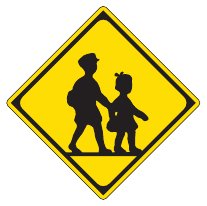 This sign warns that a school, kindergarten or nursery is nearby.
- This sign indicates that there is a pedestrian crossing at that spot.
- On a school-route road with this sign, I dropped to a speed at which I could stop at any moment in case a child ran out.
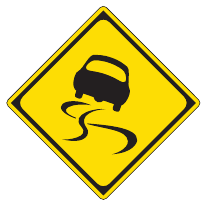 This sign warns that the road surface ahead is slippery.
- This sign warns that rocks may fall onto the road ahead.
- Seeing this sign, I reduced speed and used gentle steering and braking as I passed.
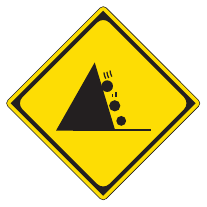 This sign warns that rocks may fall onto the road ahead.
- This sign warns that road works are in progress ahead.
- In a section with this sign, I watched not only for falling rocks but also for rocks already lying on the road.
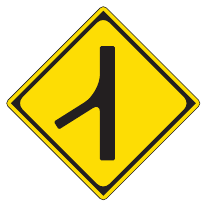 This sign warns that traffic merges in from another road ahead.
- This sign warns that the number of lanes is reduced ahead.
- Seeing this sign, I checked early, by mirror and by looking, for vehicles merging in.
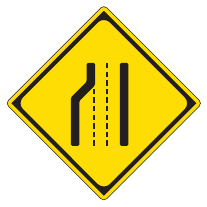 This sign warns that the number of lanes is reduced ahead.
- This sign warns that the road becomes narrower ahead.
- Seeing this sign, I signalled and moved early into the next lane in case mine was the one ending.
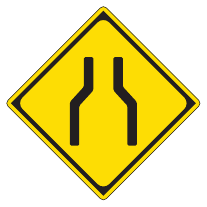 This sign warns that the road becomes narrower ahead.
- This sign warns that the number of lanes is reduced ahead.
- Seeing this sign, I slowed before the road narrowed and passed the oncoming car with a safe gap.
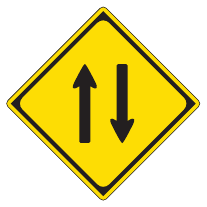 This sign warns that the road ahead carries two-way traffic.
- This sign shows that no oncoming traffic will come, that is, that the road is one-way.
- Seeing this sign, I expected oncoming traffic ahead and kept from straying right of the centre of the road.
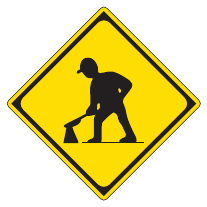 This sign warns that road works are in progress ahead.
- This sign means the road ahead is closed to all traffic.
- In a section with this sign, I slowed down and followed the directions of the road-works flagger.
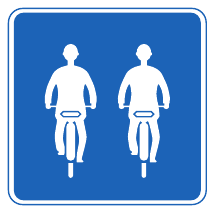 Where this sign is posted, ordinary bicycles may ride two abreast.
- This sign permits standard bicycles to ride three or more abreast.
- This sign means that cars may drive two abreast.
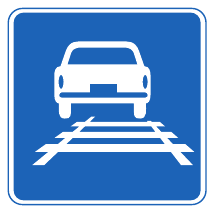 Where this sign is posted, motor vehicles may drive on the tramway.
- A car allowed onto the tram tracks by this sign may obstruct the passage of streetcars.
- This sign means you may park on the tramway.
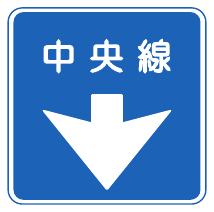 This sign shows where the centre line of the road runs.
- The centre line this sign marks is not necessarily at the middle of the road's width.
- This sign marks the boundary between lanes.
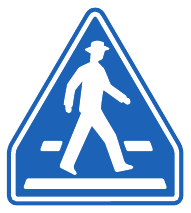 This sign indicates that there is a pedestrian crossing there.
- When a pedestrian is crossing where this sign is posted, you must stop before the crossing.
- This sign indicates that there is a bicycle crossing there.
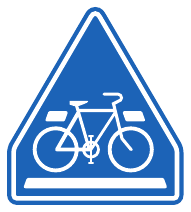 This sign indicates that there is a bicycle crossing there.
- On the area this sign marks, and within 30 metres before it, you must not pass a vehicle ahead of you and pull in front of it.
- This sign indicates that there is a pedestrian crossing there.
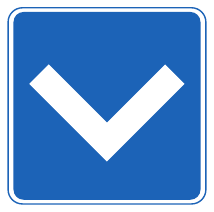 This sign indicates that there is a safety island there.
- Vehicles may not enter the area this sign marks.
- This sign indicates that there is a place to park there.
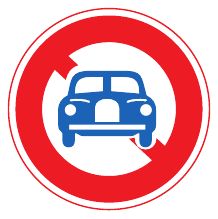 Where this sign is posted, motor vehicles other than two-wheeled ones may not pass.
- Where this sign is posted, no vehicle at all may pass.
- Where this sign is posted, large and ordinary motorcycles may still pass.
- Where this sign is posted, bicycles may not pass either.
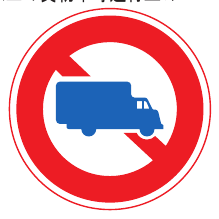 Where this sign is posted, large goods vehicles may not pass.
- Where this sign is posted, large passenger vehicles (buses) may not pass either.
- Where this sign is posted, ordinary passenger cars may still pass.
- This sign closes the road to vehicles carrying hazardous materials.
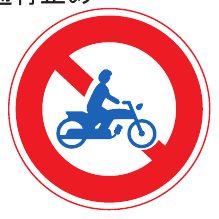 Where this sign is posted, motorcycles and general motorized bicycles (mopeds) may not pass.
- Where this sign is posted, general motorized bicycles (mopeds) may still pass.
- Where this sign is posted, bicycles may still pass.
- This sign closes the road to all motor vehicles.
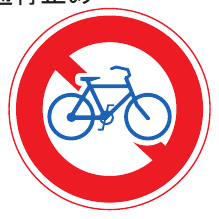 Where this sign is posted, bicycles may not pass.
- Where this sign is posted, you may not even push a bicycle through on foot.
- This sign also bars specified small motorized bicycles (electric kick scooters).
- This sign closes the road to motor vehicles.
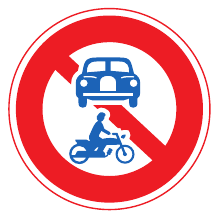 This sign bars all the vehicle types drawn on its face together.
- This sign bars only one of the vehicle types drawn on it.
- Vehicle types not drawn on this sign may still pass.
- This sign also bars pedestrians.
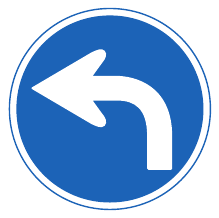 Where this sign is posted, you may not travel in any direction other than the one the arrow shows.
- At an intersection with this sign, my destination lay straight ahead, so I drove straight on.
- This sign limits vehicles to a single permitted direction: the left turn the arrow shows.
- This sign shows that the road is one-way in the direction of the arrow.
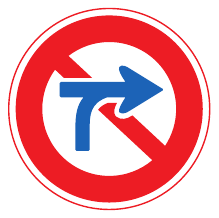 Where this sign is posted, you must not turn right across the road to enter premises beside it.
- Where this sign is posted, you may still turn left into premises beside the road.
- This sign bans making a U-turn, rather than crossing the road.
- On a road with this sign, you cannot even turn right at an intersection into another road.
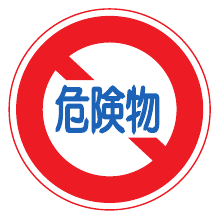 Where this sign is posted, vehicles carrying hazardous materials may not pass.
- This sign closes the road to every goods vehicle carrying a load.
- Where this sign is posted, vehicles not carrying hazardous materials may still pass.
- This sign closes the road to heavy vehicles.
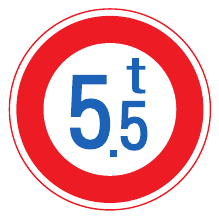 This sign closes the road to vehicles heavier than the weight shown on its face.
- The weight this sign limits is only that of the load being carried.
- This sign limits the height of vehicles.
- Where this sign is posted, vehicles not exceeding the weight shown may still pass.
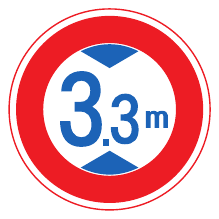 This sign closes the road to vehicles taller than the height shown on its face.
- The height this sign shows does not include the height of the load being carried.
- This sign limits the width of vehicles.
- Where this sign is posted, a vehicle taller than the figure shown may not pass and must take another route.
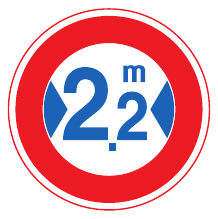 This sign closes the road to vehicles wider than the width shown on its face.
- The width this sign shows does not include the width of the load being carried.
- This sign warns that the road becomes narrower ahead.
- This is a regulatory sign, and passing in breach of it is an offence.
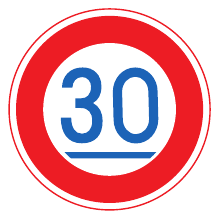 This sign means you must not drive slower than the speed shown on its face.
- This sign means you must not drive faster than the speed shown on its face.
- Where this sign is posted, you must drive at the speed shown even when congestion makes it impossible.
- You can tell this sign from the maximum speed sign by the line drawn under the figure.
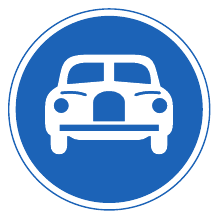 This sign marks a national expressway or a motor-vehicle-only road.
- Where this sign is posted, general motorized bicycles (mopeds) may also pass.
- Where this sign is posted, pedestrians may not walk.
- This sign marks a car park reserved for motor vehicles.
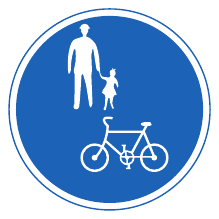 This sign marks a road that only ordinary bicycles and pedestrians may use.
- Where this sign is posted, motor vehicles may also pass.
- Where this sign is posted, cyclists must ride with care for pedestrians.
- This sign means that only pedestrians may use the road.
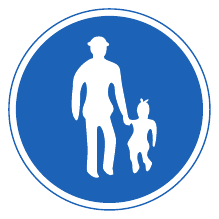 This sign marks a road that only pedestrians may use.
- Where this sign is posted, bicycles may still pass.
- A vehicle allowed onto the road this sign marks must slow right down and take particular care of pedestrians.
- This sign means that pedestrians may not cross the road.
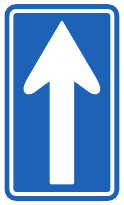 This sign bars vehicles from travelling in the direction opposite to the arrow.
- Where this sign is posted, you may not travel in the direction of the arrow either.
- On a road with this sign, vehicles may travel only in the direction the arrow shows.
- This sign means you may turn only in that direction.
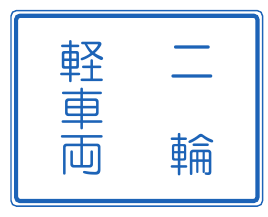 This sign assigns each type of vehicle to a particular lane.
- Where this sign is posted, you may use whichever lane you like.
- This sign assigns lanes according to the direction of travel.
- Using a different lane in breach of this sign is an offence.
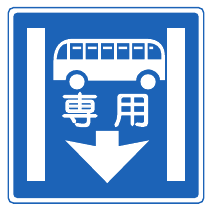 This sign marks a lane that the vehicles shown on the plate must use.
- Vehicles other than the one shown may not use this lane even in order to turn.
- This sign means only that the vehicle shown has priority.
- For a vehicle other than the one shown, continuing along this lane is an offence.
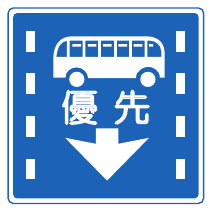 This sign marks a lane where route buses and similar vehicles have priority.
- Vehicles other than route buses may not use the lane this sign marks.
- Where congestion means you could not leave the lane this sign marks, motor vehicles other than route buses must not use it.
- This sign marks a lane reserved exclusively for route buses.
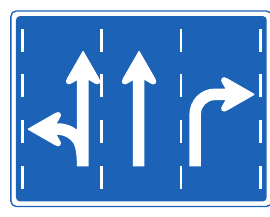 This sign assigns lanes according to the direction each will take at the intersection.
- At an intersection with this sign, I turned right out of a lane marked with a straight-ahead arrow.
- Where this sign is posted, you must use the lane assigned to the direction you intend to take.
- This sign assigns lanes according to the type of vehicle.
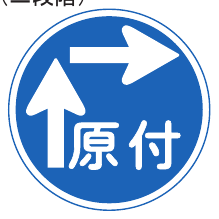 At an intersection with this sign, general motorized bicycles (mopeds) must make a two-stage right turn.
- At an intersection with this sign, general motorized bicycles (mopeds) turn right the same way cars do.
- This sign also dictates how motor vehicles must turn right.
- An general motorized bicycle (moped) turning right at an intersection with this sign must first keep to the left edge of the road.
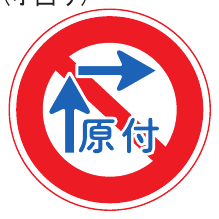 At an intersection with this sign, general motorized bicycles (mopeds) must turn right the same way cars do.
- At an intersection with this sign, general motorized bicycles (mopeds) must make a two-stage right turn.
- An general motorized bicycle (moped) turning right at an intersection with this sign must first move as close as it can to the centre of the road.
- This sign prohibits general motorized bicycles (mopeds) from turning right.
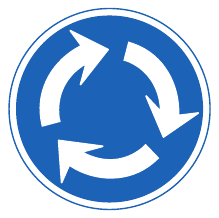 This sign requires traffic in a roundabout to circulate clockwise.
- At a roundabout with this sign, traffic circulates anticlockwise.
- This sign shows both that the junction is a roundabout and how to travel through it.
- This sign bans making a U-turn at a roundabout.
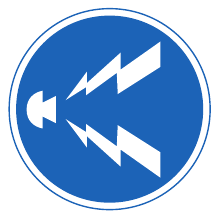 Where this sign is posted, you must sound your horn.
- Whether to sound the horn where this sign is posted is left to the driver's judgement.
- This sign prohibits the use of the horn.
- This is a blue disc and is a regulatory sign.
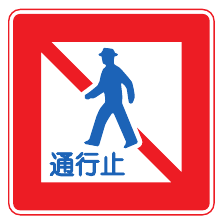 This sign closes the road to pedestrians.
- This sign closes the road to vehicles.
- This sign is addressed to pedestrians rather than to drivers.
- This sign bans pedestrians only from crossing the road.
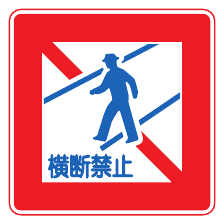 This sign prohibits pedestrians from crossing the road.
- Where this sign is posted, pedestrians may not even walk along the road.
- This sign prohibits vehicles from crossing the road.
- To reach the other side where this sign is posted, you must use a nearby crossing or footbridge.
- This sign is used where the view is poor and the signal is easy to miss.
- This sign warns that the traffic signal ahead is out of order.
- Even with this sign, whether you go or stop is decided by what the signal shows.
- The sign alone does not say what the danger is, so you must read the situation on the spot.
- This sign means the road ahead is closed.
- This is a regulatory sign.
- Where this sign is posted, streetcars may not pass either.
- Where this sign is posted, you may still pass if you push your bicycle on foot.
- This is a round regulatory sign with a red rim.
- Where this sign is posted, you may still pass if you walk pulling a handcart.
- The face of this sign is empty because it applies to vehicles in general.
- This sign bars two-wheelers only.
- This sign is placed at the exit end of a one-way street.
- Where this sign is posted, pedestrians may not enter either.
- You should expect vehicles to come out of a road carrying this sign.
- Where this sign is posted, you may not turn left either.
- This sign means the road ahead is a dead end.
- This is a blue disc and a regulatory sign dictating which way you may go.
- This sign prohibits turning right as well.
- On a road with this sign I overshot my destination, but instead of making a U-turn there, I turned around after passing the signed section.
- This is a warning sign.
- Where this sign is posted, you may still overtake as long as you do not cross onto the right-hand side.
- This sign prohibits crossing onto the right-hand side even when not overtaking.
- It is not this sign but the "no overtaking" sign that bans overtaking itself.
- Where this sign is posted, you may still stop if it is to prevent danger.
- At a place with this sign, I stopped the car for just a few minutes to shop at a convenience store.
- You can tell this sign from the no-parking sign by its X, rather than a single diagonal bar.
- This sign restricts less than the sign that bans parking only.
- Where this sign is posted, a stop to load or unload goods lasting no more than five minutes does not count as parking.
- This sign means the same as the no-stopping-or-parking sign.
- Where this sign is posted, leaving your vehicle so that you cannot drive it away at once is an offence.
- Where this sign is posted, you may drive more slowly than the speed shown.
- On a road with this sign, you may exceed the posted speed while overtaking.
- This sign also applies to roads where no speed is posted.
- On a road with this sign, vehicles may travel across onto the right-hand side of the road.
- This sign also dictates which way pedestrians must walk.
- The exit end of a road with this sign usually carries a no-entry sign.
- The slow-down requirement of this sign applies to streetcars as well as vehicles.
- On a road with this sign, there was no vehicle ahead of me, so I passed through with hardly any reduction in speed.
- This sign shares its downward-triangle shape with the stop sign.
- Where this sign is posted but no stop line is marked, you need not stop.
- At an intersection with this sign, I stopped completely and waited for a gap in the crossing traffic before moving off.
- This sign is a red downward triangle lettered 止まれ.
- The duty to stop under this sign arises where it is designated at, or just before, an intersection without traffic control.
- With this sign, you may park even where you would obstruct other traffic.
- This sign means you may only stop there, not park.
- This sign is a blue square with a white P on it.
- Vehicles coming from a road that crosses one with this sign must not obstruct traffic on the priority road.
- If you are on a road with this sign, you need not check that an intersection is safe.
- This is a blue square instruction sign.
- Where this sign is posted, only trams must not pass.
- On a road with this sign, not only vehicles but pedestrians too must not pass.
- Where this sign is posted, pedestrians must not enter from that direction either.
- At an intersection with this sign, you must not proceed in the direction the arrow shows either.
- The ban imposed by this sign extends to right turns at intersections.
- On a road with this sign, I crossed the centre line into the right-hand side of the road to overtake the vehicle ahead.
- The ban imposed by this sign also applies to pedestrians standing still.
- This sign also bans brief stops to let people on or off.
- A vehicle on a road with this sign must not travel below the speed shown.
- Where this sign is posted, you must not travel in the direction the arrow shows either.
- The slow-down requirement of this sign also applies to pedestrians.
- This sign also requires pedestrians about to cross to stop.
- This sign prohibits parking.
- A vehicle on a road with this sign must not slow down when entering an intersection.
- Where this sign is posted, a vehicle must not stop.
- This sign warns of a hazard, so vehicles must not travel through the section beyond it.
- Where this sign is posted, you must not go straight through the intersection.
- Where this sign is posted, you must not turn right.
- Where this sign is posted, you must not proceed in any direction other than the one shown.
- Where this sign is posted, a vehicle must not stop just before the railway crossing.
- Where this sign is posted children may run out, so vehicles must not pass.
- Where this sign is posted, you must not use the brakes.
- Where this sign is posted there is a risk of falling rocks, so you must not park.
- Where this sign is posted, you must not give way to vehicles merging in.
- Where this sign is posted, you must not change course.
- Where this sign is posted, you must not pass an oncoming vehicle.
- Where this sign is posted, you must not overtake.
- Where this sign is posted road works are under way, so vehicles must not pass.
- Where this sign is posted, two-wheeled motor vehicles must not pass either.
- Where this sign is posted, ordinary goods vehicles must not pass either.
- Where this sign is posted, bicycles must not pass either.
- The closure imposed by this sign also applies to pedestrians.
- Where this sign is posted, vehicle types not drawn on the plate must not pass either.
- What this sign prohibits is travel in the direction the arrow shows.
- The ban imposed by this sign also applies when turning left into premises off the road.
- Where this sign is posted, vehicles not carrying dangerous goods must not pass either.
- Where this sign is posted, vehicles under the weight shown must not pass.
- What this sign bans is vehicles lower than the height shown.
- Where this sign is posted, vehicles narrower than the width shown must not pass.
- A vehicle on a road with this sign must not travel above the speed shown.
- On a road with this sign, motor vehicles must not pass either.
- On a road with this sign, pedestrians must not pass.
- On a road with this sign, pedestrians must not pass, even someone with business at a building along it.
- The direction-of-travel restriction of this sign also applies to pedestrians.
- An emergency vehicle approached on a road with this sign, but I assumed I must stay in my designated lane and did not give way.
- Only the designated vehicles may use the lane marked by this sign; others must not use it even to turn left.
- Vehicles other than route buses must not use the lane marked by this sign.
- This sign bans passing through the intersection altogether.
- At an intersection with this sign, a general motorized bicycle (moped) must not turn right.
- At an intersection with this sign, a general motorized bicycle (moped) must not turn right the same way a car does.
- At a roundabout with this sign, you must go anticlockwise and must not go clockwise.
- This sign prohibits the use of the horn.
- Where this sign is posted, vehicles must not pass either.
- What this sign prohibits is vehicles crossing the road.
- This sign prohibits standard bicycles from riding side by side.
- This sign prohibits cars from driving on the tram tracks.
- Where this sign is posted, you must not overtake at all.
- Where this sign is posted, a vehicle must not pass over the pedestrian crossing.
- Where this sign is posted, bicycles must not cross the road.
- Where this sign is posted, pedestrians must not enter.
- I drove slowly into a road bearing this sign.
- A vehicle on a road with this sign must proceed slowly.
- This sign stood at the exit of a one-way street, but I stopped first and then drove in from that side.
- This sign demands that vehicles going the arrow's way first come to a stop.
- Even where this sign is posted, you may make a U-turn as long as you signal beforehand.
- This sign requires vehicles to slow right down while overtaking.
- Where this sign is posted, you may not stop your vehicle even to avoid danger.
- Where this sign is posted, stopping to let people on or off is limited to five minutes.
- A vehicle on a road with this sign must travel at the speed shown.
- On a road with this sign, going against the arrow is allowed as long as you crawl.
- To obey this sign you must not only slow to a speed from which you can stop at once, but also come to a complete stop.
- To obey this sign, it is enough to creep past the stop line at the slowest possible speed without fully stopping.
- This sign obliges passing vehicles to park there.
- A vehicle on a road with this sign must give way to vehicles on the crossing road at an intersection.
- This sign demands a complete stop even when the signal is green.
- This sign warns that there is a hazard, so a vehicle must slow right down beyond it.
- This sign obliges vehicles to stop before the intersection.
- Where this sign is posted, you are required to sound the horn.
- This sign legally requires vehicles to slow to a crawl before the bend.
- The required stop is made just before this sign, not just before the crossing itself.
- Where this sign is posted, you may proceed only after coming to a complete stop.
- This sign makes tyre chains compulsory.
- In a section with this sign, you must drive with the windows closed.
- This sign obliges merging vehicles to come to a complete stop.
- This sign obliges vehicles to move into the left lane.
- Where this sign stands, slowing to a crawl before passing oncoming traffic is compulsory.
- This sign tells drivers to switch their headlights to low beam.
- This sign obliges vehicles to take a detour.
- This sign tells motorcycles to slow to a crawl.
- I drove my heavy goods vehicle slowly into a road bearing this sign.
- This sign bans even dismounting and pushing a motorcycle through on foot.
- I rode my electric kick scooter slowly into a road bearing this sign.
- This sign tells the vehicles pictured on it to slow to a crawl.
- At an intersection with this sign, you must stop before proceeding in the arrow's direction.
- At a place with this sign, I crossed the road at a crawl, turning right into a car park on the far side.
- Driving a tanker loaded with kerosene, I entered a tunnel bearing this sign at a crawl.
- This sign tells vehicles over the weight shown to slow to a crawl.
- This sign obliges vehicles exceeding the height shown to unload their cargo.
- My vehicle, load included, was wider than the figure on the sign, but I drove through anyway, thinking slow driving would make it safe.
- A vehicle on a road with this sign must travel at exactly the speed shown.
- Travelling in the arrow's direction on a road with this sign requires you to slow to a crawl.
- The lane marked by this sign is one that the designated vehicles must use.
- A vehicle other than a route bus using the lane marked by this sign must stay in that lane even when a route bus approaches.
- This sign requires a complete stop before moving into the designated lane.
- At an intersection with this sign, cars must also make the right turn in two stages.
- At an intersection with this sign, a general motorized bicycle (moped) must move to the left edge of the road before turning right.
- A vehicle about to enter a roundabout with this sign must come to a complete stop.
- To obey this sign you must come to a complete stop in addition to sounding the horn.
- When a traffic light and a police officer’s hand signal differ, pedestrians and vehicles must follow the traffic light.
- At night, when meeting an oncoming vehicle, you must switch to high beam so that it can see you.
- When about to enter a roundabout, you must signal at a point 30 metres before it.
- After you finish turning or changing course, you must keep signalling until the next intersection.
- At an intersection with poor visibility you must always sound your horn, even where no sign designates it.
- Even where this sign is posted, pedestrians may pass.
- Even where this sign is posted, people may walk through.
- Even where this sign is posted, two-wheeled motor vehicles may pass.
- Even where this sign is posted, ordinary goods vehicles may pass.
- Even where this sign is posted, bicycles may pass.
- Even where this sign is posted, a vehicle not carrying dangerous goods may pass.
- Even where this sign is posted, a vehicle not exceeding the weight shown may pass.
- Even where this sign is posted, a vehicle not exceeding the height shown may pass.
- Even where this sign is posted, a vehicle not exceeding the width shown may pass.
- On a road with this sign you may travel above the speed shown.
- Vehicles other than route buses may also use the lane marked by this sign.
- Even in the reserved lane marked by this sign, a vehicle other than the designated types may use it in order to turn left.
- Even where this sign is posted, vehicles may pass.
- Where this sign is posted, you may travel in the direction the arrow shows.
- At an intersection with this sign, I drove on in the direction the arrow shows.
- Even where this sign is posted, a vehicle may drive straight through when no pedestrian is about to cross.
- Waiting for a streetcar, I stepped as a pedestrian into the safety zone marked by this sign.
- On a road with this sign, my friend and I rode our bicycles two abreast.
- Driving on the tram tracks where this sign allows it, I promptly moved off the tracks when a streetcar approached.
- At a place with this sign, I checked there was no supplementary board limiting hours or vehicle types, then parked.
- At night, when meeting an oncoming vehicle, you do not have to switch off or dim your lights if there is no risk of obstructing it.
- You do not have to signal when you are about to enter a roundabout.
- Even at an intersection with poor visibility, you do not have to sound your horn where no sign designates it.
- At a place with this sign, I did not stop completely but passed through after slowing to a speed from which I could stop at once.
- I saw this sign, but the signal ahead was green, so I carried on without stopping.
- You do not have to stop before the intersection merely because this sign is there.
- Where this sign is posted, you do not have to abandon an overtaking manoeuvre that does not cross into the right-hand side of the road.
- Where this sign is posted, you do not need permission each time you halt to let people get in or out.
- A vehicle on a road with this sign does not have to slow down even when entering an intersection with poor visibility.
- Where this sign is posted, pedestrians do not have to walk in the direction of the arrow.
- At a place with this sign, I sounded the horn and passed through at reduced speed without stopping completely.
- A vehicle about to enter a roundabout with this sign does not have to come to a complete stop.
- The light was green, but a police officer signalled me to stop by hand, so I stopped.
- At night, meeting an oncoming vehicle, I risked dazzling it, so I dipped my headlights.
- As I left the roundabout, I signalled with my indicator.
- After finishing my lane change, I left the indicator on for a while as I drove.
- Thinking I could get through on foot, I got off and pushed my vehicle past this sign.
- I got out and walked through past this sign.
- This road was a short cut, so I drove into it past this sign.
- At an intersection with this sign, I turned in a direction the arrow did not show.
- I had taken a wrong turn, so I made a U-turn where this sign is posted.
- Where this sign is posted, I overtook the vehicle ahead without crossing into the right-hand side of the road.
- I halted briefly to let someone out where this sign is posted.
- Where this sign is posted, I halted to let someone out and moved off straight away.
- On a road with this sign, I drove below the speed shown.
- Where this sign is posted, I drove against the arrow.
- Where this sign is posted, I slowed to a speed from which I could stop at once.
- At an intersection with this sign I saw no traffic either way, so I rolled through slowly without stopping.
- I parked my car where this sign is posted.
- On a road with this sign, entering an intersection with poor visibility, I did not slow down but checked that it was safe and went on.
- Seeing this sign, I slowed down ready for the traffic lights ahead.
- Seeing this sign, I slowed down on the basis that I did not know what was ahead.
- Seeing this sign, I slowed down ready for the crossroads ahead.
- Seeing this sign, I slowed down ready for the T-junction ahead.
- Seeing this sign, I slowed down before the bend ahead.
- After seeing this sign, I went over the railway crossing without stopping just before it.
- Where this sign is posted, I saw no children, so I sped up as I went past.
- Where this sign is posted, I kept my usual speed and braked hard before the bend.
- Where this sign is posted, I slowed down and watched for rocks on the road.
- Seeing this sign, I slowed down on the basis that traffic would be merging in.
- Where this sign is posted, I stayed in the lane that ended and moved into the next one without signalling.
- Seeing this sign, I slowed down because the road was going to narrow.
- Seeing this sign, I kept away from the centre because oncoming traffic was expected.
- Seeing this sign, I slowed down ready for the road works.
- I rode my standard motorcycle past this sign.
- I drove a large goods vehicle past this sign.
- I rode a general motorized bicycle (moped) past this sign.
- I rode my bicycle past this sign.
- I drove along this road in a vehicle of a type drawn on the plate of this sign.
- At an intersection with this sign, I went the way the arrow showed.
- Where this sign is posted, I turned right across the road to get to a shop on the other side.
- I drove past this sign in a vehicle carrying no dangerous goods.
- I drove along this road in a vehicle heavier than the weight shown on this sign.
- I drove along this road in a vehicle taller than the height shown on this sign.
- I drove along this road in a vehicle no wider than the width shown on this sign.
- On a road with this sign, I drove slowly, below the speed shown.
- I rode a bicycle along a road with this sign.
- I walked along a road with this sign.
- A road with this sign was a short cut, so I drove through it.
- Where this sign is posted, I travelled in the direction of the arrow.
- I drove in a lane other than the one this sign assigns to my type of vehicle.
- I used the reserved lane marked by this sign briefly in order to turn left.
- I was in the lane marked by this sign and a route bus came up behind, but I stayed where I was.
- This sign assigned a lane for turning right, but I turned right from the straight-ahead lane.
- At an intersection with this sign, riding a general motorized bicycle (moped), I turned right the same way a car does.
- At an intersection with this sign, riding a general motorized bicycle (moped), I turned right the same way a car does.
- I went round a roundabout with this sign clockwise.
- Where this sign is posted, there were no other vehicles, so I went past without sounding my horn.
- I walked through where this sign is posted.
- Where this sign is posted, no cars were coming, so I walked across the road.
- Where this sign is posted, I rode side by side with a friend on our bicycles.
- Where this sign is posted, I drove on the tramway strip.
- I followed the centre line this sign marks and drove on its left.
- Where this sign is posted, a pedestrian was about to cross, so I stopped just before it.
- Where this sign is posted, I rode across on the bicycle crossing without dismounting.
- Where this sign is posted, there were pedestrians in the safety zone, but I passed at the same speed.
- I had held my semi-medium licence for less than a year, but I drove with the mark on the front only.
- Age-related decline in my physical function might have affected my driving, so I drove with the older-driver mark displayed.
- Being towed by another vehicle, I drove without the towed vehicle’s headlight lit.
- I was about to go through an intersection with poor visibility where a sign designates sounding the horn, so I sounded it.