Japanese Signs That Mean the Opposite of What You Assume: Crosswind, End of Restriction, Minimum Speed
Last updated: 30 July 2026
A handful of Japanese signs are misread not because they are hard to see but because their name and their legal effect point in different directions. The six that catch people most often: crosswind (横風注意) is a warning of side wind, not of a wind-powered anything; the "End" plate (終わり) marks where a restriction stops, never where it starts; the minimum speed sign (最低速度) is the maximum-speed sign with a line under the number, and it sets a floor rather than a ceiling; no parking (駐車禁止) carries one diagonal bar while no stopping or parking (駐停車禁止) carries an X; several signs are named after the roadside, not the duty (通学路 is about small children, 動物注意 is about animals running out, 警笛鳴らせ orders you to use the horn); and a green arrow overrides a red light for cars but not for bicycles.
What does the crosswind sign mean in Japan?
The crosswind sign (横風注意, yokofū chūi) warns that strong side wind may hit you — nothing more. It is a warning sign, so it is a yellow diamond, and under the Order on Road Signs it is sign No. 214, placed 50 to 200 metres before the exposed spot.
It is a warning, not a prohibition: no speed is imposed and no manoeuvre is banned. What it asks is that you hold the wheel firmly and slow down before the gust, typically on a bridge or at the exit of a tunnel or cutting — the places where the shelter suddenly disappears and the car is pushed sideways.
Practise it: the crosswind sign statement and side wind at a tunnel exit.
What does an "End" plate under a sign mean? (restriction end sign)
A plate reading 終わり ("End") means the restriction shown by the sign above it stops here. It never means the restriction begins here — that is the job of the separate 始まり ("Start") plate.
These are supplementary plates (補助標識): small plates fixed under a main sign that narrow it down. The Order on Road Signs numbers the set — 始まり (Start, No. 505), 区間内 (Within the section, No. 506) and 終わり (End, No. 507) — and the Rules of the Road describe the same three as marking the start, the middle and the end of the regulated stretch.
The reason this trips people up is that Japanese regulations are often signed over a stretch of road rather than at a single point, so the same main sign is repeated with a different plate. Read the plate before you conclude anything: a plate can also give days and hours, or a vehicle type, and those change the answer completely.
Practise it: the "End" plate, what supplementary plates do, and the "Day/Time" plate.
Minimum speed sign meaning: it is the underline
The minimum speed sign (最低速度, saitei sokudo — sign No. 324) sets a speed you must not go below, and the only thing that distinguishes it from the maximum speed sign is the line drawn under the number. Cover the underline and the two are the same picture with opposite meanings.
That is the whole recognition problem, and it is worth learning as a pair rather than as two separate facts: line under the number → floor; no line → ceiling. A posted maximum never doubles as a minimum, either.
For what the duty actually requires — Article 23, the two exceptions that make "never, under any circumstances" a false statement, and how the minimum works on an expressway — see Entering a Japanese Expressway.
Practise it: the underline, the maximum speed sign it is confused with, the duty itself.
No parking vs no stopping — and the same rules painted on the road
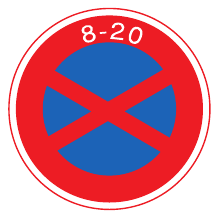
One diagonal bar means no parking (駐車禁止, No. 316). An X means no stopping or parking (駐停車禁止, No. 315). Both are red on blue, and the difference between them is whether you may pause at all.
The same two rules also appear as road markings painted on the surface, and here is the point people miss: markings come in only two kinds — regulatory markings (規制標示) and instruction markings (指示標示). There is no such thing as a "warning marking". A no-parking marking, like a bus-lane marking, is a regulatory marking; a marking that permits diagonal crossing is an instruction marking. A sign and a marking carrying the same rule have the same force, so the absence of a signboard does not mean the absence of a restriction — look down as well as up.
Practise it: telling the X from the bar, how many kinds of marking there are, no-parking markings, and the diagonal-crossing marking.
Signs whose Japanese name points the wrong way
Several signs are named after the thing beside the road rather than the thing you must do, and translating the name literally produces the wrong answer. Four that are tested repeatedly:
- 通学路 (School route) — a stretch used by children walking to primary school, kindergarten or nursery. Nothing to do with university students, despite 学 meaning "study".
- 動物注意 (Animal crossing) — animals may run out onto the road. It does not mark a route used by vehicles carrying animals.
- 警笛鳴らせ (Sound your horn) — a blue disc, and blue means "you must". It is an order to sound the horn, not a ban on using it, and it does not require a stop. Its relative, 警笛区間 (Horn zone), applies only where you cannot see: within the zone you sound the horn at blind intersections, blind bends and blind crests — not at intersections with a clear view.
- 駐車余地 (Parking space required) — you must leave at least the distance on the plate on the right side of your parked car, not the left.
A fifth pair is directional rather than lexical. 一方通行 (One-way, No. 326) bans travel in the direction opposite the arrow — the arrow shows where you may go. 指定方向外進行禁止 (No. 311) looks similar but does something else: it restricts you to the arrows shown, without making the street one-way.
Practise it: the school-route sign, the animal sign, the horn sign is not a ban, the horn zone, which side the parking space goes, the one-way arrow, why No. 311 is not one-way.
Green right arrow: what it allows, and who may not follow it
A green arrow signal lets vehicles proceed in the direction of the arrow even though the main light is yellow or red, under Article 2 of the Order for Enforcement of the Road Traffic Act. When the arrow points right, it also permits a U-turn — a point that surprises drivers from countries where an arrow only ever means "turn".
Two restrictions matter. First, the right-pointing green arrow does not apply to bicycles and other light vehicles, specified small motorized bicycles (e-scooters), or mopeds making a two-stage right turn — those must wait for the main light. Second, a yellow arrow is only for streetcars; pedestrians and ordinary vehicles must not move on it, however tempting it looks at a tram junction.
Practise it: the green arrow with a red light, the U-turn it permits, who is excluded, and the yellow arrow.
FAQ
- What does the crosswinds sign mean in Japan?
- It is a warning sign (No. 214, a yellow diamond) telling you that strong side wind may occur ahead and that care is needed. It imposes no speed limit and bans nothing; it is placed 50 to 200 metres before the exposed spot, typically a bridge or a tunnel exit.
- What does the "End" sign mean?
- A supplementary plate reading 終わり (No. 507) marks the end of the stretch covered by the sign above it. The plate reading 始まり (No. 505) marks the start, and 区間内 (No. 506) means you are inside the regulated stretch.
- How do I tell the minimum speed sign from the maximum speed sign?
- By the line under the number. Minimum speed (No. 324) has a line under the figure and sets a speed you must not drop below; maximum speed has no line and sets a ceiling. You may drop below the minimum only where another rule requires you to slow down or where it is unavoidable to prevent danger.
- Does a green right arrow let me make a U-turn in Japan?
- Yes. A right-pointing green arrow permits both a right turn and a U-turn, even while the main light is red. It does not apply to bicycles and other light vehicles, e-scooters, or mopeds performing a two-stage right turn.
- Is a road marking as binding as a signboard?
- Yes when it is a regulatory marking. Markings come in two kinds only, regulatory and instruction; a no-parking marking is regulatory and binds you exactly as the equivalent sign would.
- Does the Japanese no-passing sign ban overtaking?
- It depends which of the two you are looking at. No. 314 bans only crossing into the right half of the road in order to overtake, so overtaking inside your own half is still allowed; No. 314-2, the same disc with an extra plate reading 追越し禁止, bans overtaking itself. The overtaking guide on this site works through both.
Practise with a full 50-question mock test, free.
Start a 50-question testAdvertisement
Related questions
Browse questions by topic
Related terms
Sources
- e-Gov — Order on Road Signs, Road Lines and Road Markings (sign numbers 214, 311, 314, 314-2, 315, 316, 324, 326, 505-507) (official source)
- e-Gov — Road Traffic Act (Art. 8 signed prohibitions and directions, Art. 23 minimum speed, Art. 44 stopping and parking, Art. 54 sounding the horn) (official source)
- e-Gov — Order for Enforcement of the Road Traffic Act, Art. 2 (meaning of green and yellow arrow signals) (official source)
- Rules of the Road (National Public Safety Commission Notification No. 3) — two kinds of marking, supplementary plates, Appendix Tables 1 and 3 (official source)
- MLIT — road-sign basics (colours and shapes of each family) (official source)
Update history
- 30 July 2026 — First published.